


The Post-Funding Hiring Playbook For U.S. and Canada Companies
How to Build the Right Team After Raising Capital
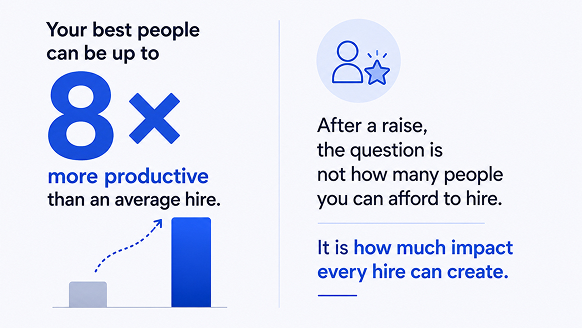
Raising a round changes the math on almost everything, and hiring is where founders feel it first. New capital creates pressure to grow the team quickly, and headcount becomes an easy proxy for progress. The problem is that headcount and impact are not the same thing. A funded company in the U.S. can add twenty people and move slower than a competitor who added five.
This playbook lays out how to turn a fresh raise into the right team: which roles to hire, in what order, where to find the talent, and what to do after the offer is signed.
1. Start With Your Milestones, Not Your Org Chart
The strongest hiring plans do not start with a list of titles. They start with the business. Every hire should trace back to a single question: what does this person help us achieve before the next major milestone?
Your round was raised against a set of expectations. The hiring plan is how you meet them. Before you open a single requisition, work through five questions in order.
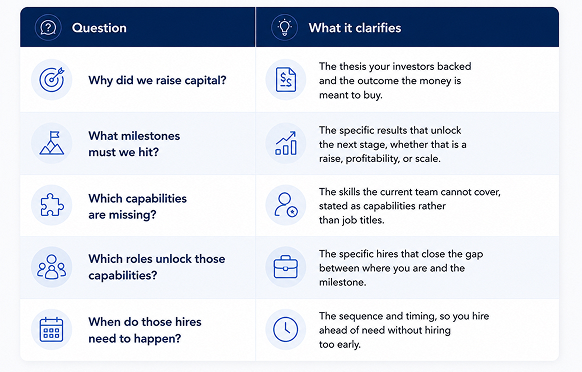
Different goals require different teams. A company raising to launch a product hires very differently from one raising to accelerate revenue or expand into a new region. Mapping capital to objectives to milestones to skill gaps to roles gives you a hiring roadmap instead of a wish list.
Source: https://carta.com/learn/startups/compensation/hiring-plan/
2. Prioritize Roles by ROI, Not by Urgency
A loud common problem in U.S. companies is not always the most valuable problem to solve.
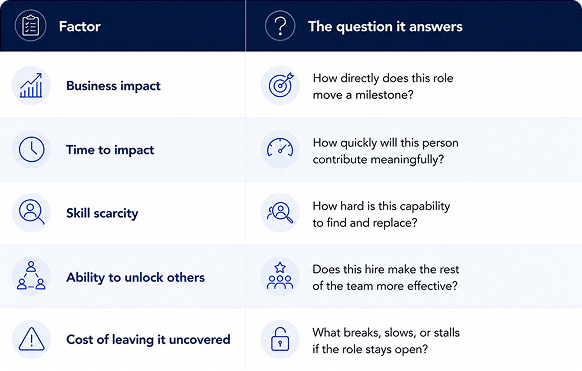
Once the roadmap exists, the next trap is sequencing by noise. The role that feels most urgent, usually the one attached to whoever is complaining loudest, is often not the role that creates the most value. A useful hiring plan ranks positions by return, not by volume of internal pressure. Score each candidate role against five factors.
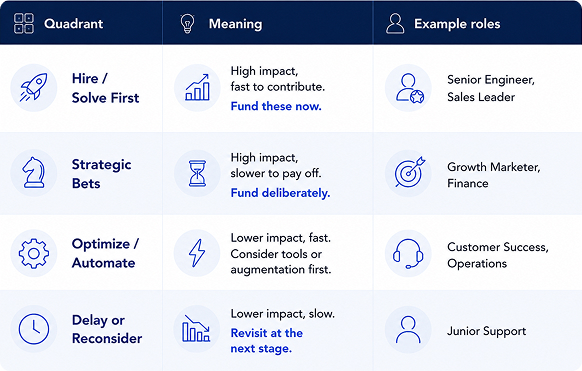
Plotting roles on a simple grid of business impact against time to impact turns the plan into four clear decisions.
Source: https://carta.com/uk/en/learn/startups/compensation/headcount-planning/
3. Build Smaller, Hire Stronger, Amplify With AI
The default model of the last decade was simple: more capital meant more people. That model is quietly being retired. The companies scaling well today follow a different equation. Better talent plus AI leverage produces more output per employee, and the data backs it up.
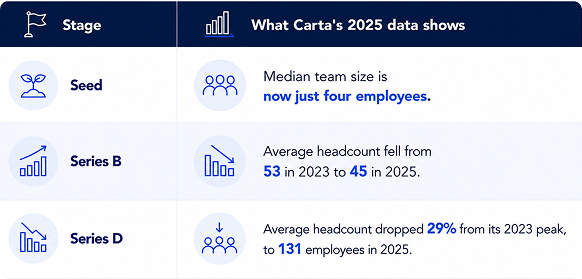
As teams get leaner, the capital per remaining employee goes up, and so does the payoff for hiring stronger people. On Carta, median individual-contributor salaries rose 6.4% over two years while initial equity grants grew roughly 11%. Companies are spending more per person because each person carries more of the load.
AI is the multiplier underneath this shift. In BCG's 2026 AI at Work survey, 42% of frontline employees who use AI regularly report saving around eight hours a week, the equivalent of a full workday, and 74% of frontline employees are now regular AI users. The leverage is real, but it accrues to teams that hire people who can actually use it well.
Source: https://carta.com/data/startup-compensation-h2-2025/
Source: https://www.bcg.com/publications/2026/ai-at-work-why-strategy-matters-more-than-tools
4. A Bad Hire Costs Far More Than a Salary
Salary is only the visible part of the investment.
Every hiring decision after a raise is a capital allocation decision, and the salary line is the smallest part of the bill. SHRM benchmarking puts the average cost per hire at close to $4,700, and more recent benchmarks place non-executive roles higher still. That figure only covers what shows up on an invoice. The larger cost sits below the surface.
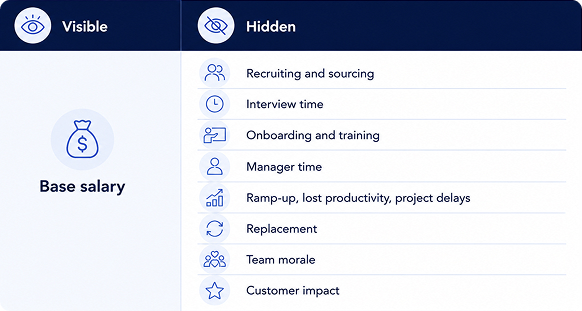
When a hire does not work out, most of those costs are paid twice. That is why the goal after funding is not to fill seats quickly. It is to raise the probability that each seat is filled correctly. Every hiring decision is also a capital allocation decision.
Source: https://www.shrm.org/topics-tools/news/talent-acquisition/real-costs-recruitment
Source: https://www.shrm.org/topics-tools/news/employee-relations/cost-bad-hire-can-astronomical
5. Win Better Talent Without Burning More Cash
Before you increase the budget, increase the size of the talent market.
Great talent does not stop at your ZIP code. When a critical role is scarce or expensive locally, the fastest lever is usually not a bigger salary band. It is a bigger search area. Hiring across borders gives funded companies access to capabilities that are hard to find or hard to afford at home.
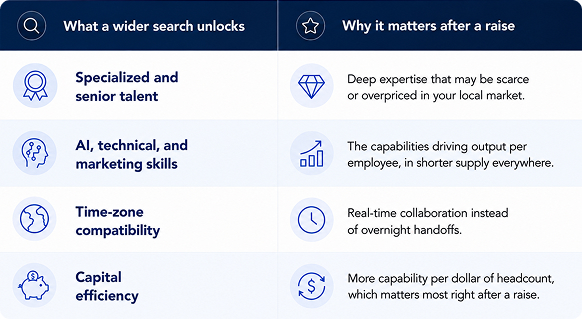
Follow that logic and Latin America keeps coming up, not as a discount, but as a serious talent market. The region combines strong digital skills, rapid AI upskilling, large professional talent pools, meaningful time-zone overlap with North America, and competitive talent economics.
The skills data is the part that surprises people. Coursera's 2025 Global Skills Report found GenAI enrollments in Latin America grew 425% year over year, the highest of any region in the world, while cybersecurity enrollments in the region rose 106%. This is a workforce upskilling in exactly the areas funded companies are hiring for.
Expand the talent pool before you expand the payroll. Evaluate for capability first, cost second.
Source: https://www.coursera.org/skills-reports/global
6. Hiring Is Only Half the Investment
Getting the right person through the door is the beginning, not the finish line. The return on a hire comes from what happens next.
The highest-return talent strategies keep working after the offer is signed. Structured onboarding, clear expectations, continuous feedback, coaching, upskilling, and real career development are what turn a good hire into a compounding one. The numbers are hard to ignore: organizations with a strong onboarding process see about 82% better new-hire retention and over 70% higher new-hire productivity, according to Brandon Hall Group research.
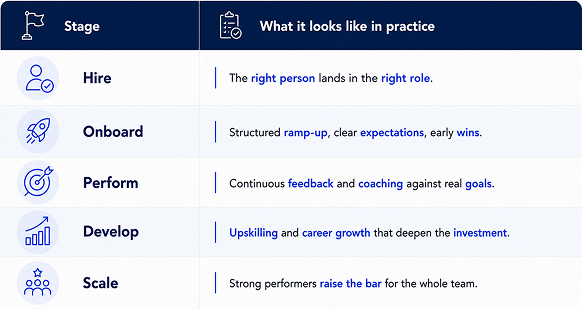
This is the principle behind how Bloom supports talent after placement. Through OPIS, our framework for supporting people beyond the hire, we help teams keep improving once someone is in the seat, because building the right team does not end on day one.
Source: https://www.mckinsey.com/featured-insights/mckinsey-explainers/what-is-talent-management
Source: https://www.brandonhall.com/
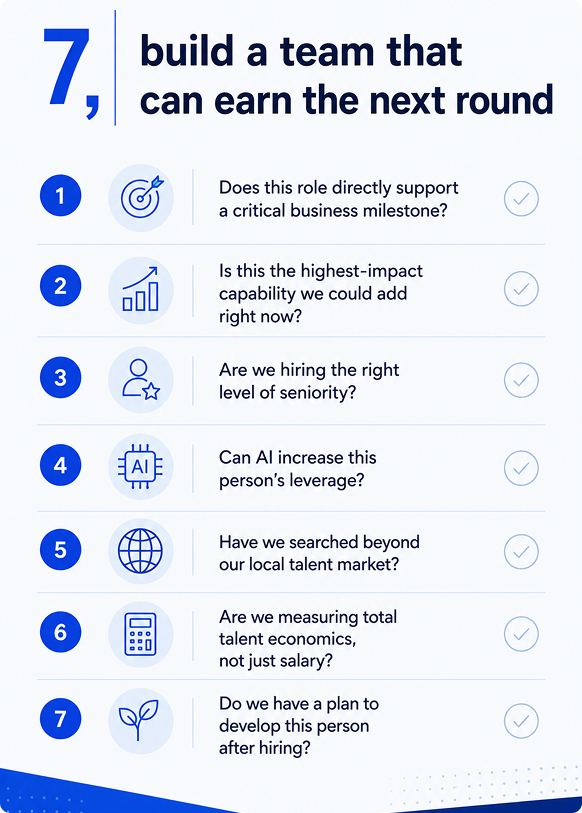
7. Build a Team That Can Earn the Next Round
A post-funding hiring plan is really a test of judgment repeated many times. Before approving any hire, run it through a short checklist. If a role cannot clear most of these, it is probably not the next hire to make.
Need help building a post-funding team across marketing and tech?
Bloom helps funded U.S. and Canada companies source, hire, and develop remote talent aligned with their growth goals, and keeps supporting performance after placement so the team you build can go on to earn the next round.