


Hiring In-House or Staff Augmentation for U.S. and Canada companies?
A practical framework for choosing the right model for every role. A decision guide for companies across the United States, Canada, and the UK.
Outsourcing Isn't Just for Back-Office Work Anymore
For a long time, outsourcing meant support functions and back-office tasks. That has changed. Today, many companies across the United States, Canada, and the UK combine internal employees with external specialists across their most specialized and business-critical work.
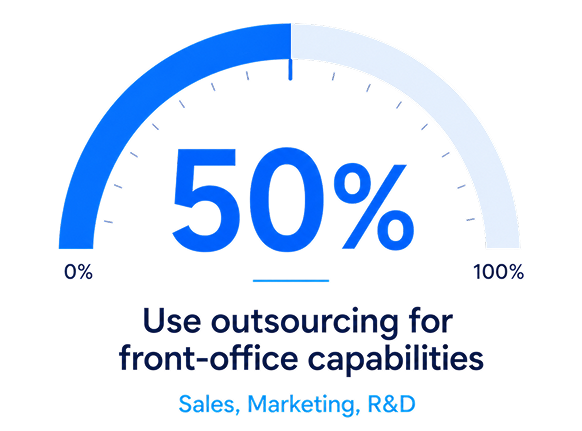
Source: https://www.deloitte.com/us/en/services/consulting/articles/global-outsourcing-survey.html
The question is no longer whether a role can be outsourced. It is whether there is a compelling reason it needs to be in-house.
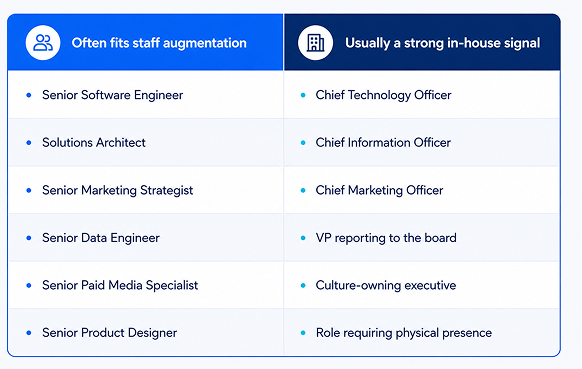
Where Each Model Tends to Fit
Notice that both columns include senior, experienced roles. Seniority is not what separates them.
The Numbers Behind the Decision
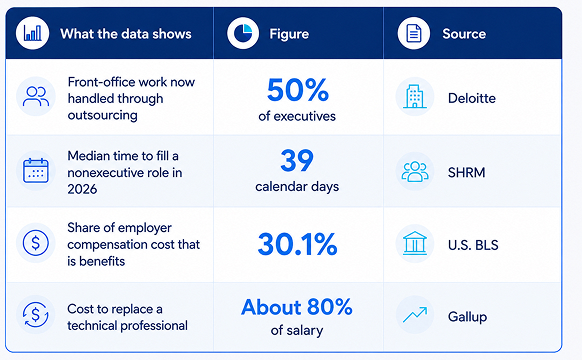
Full sources are listed in the References section below.
Some Roles Should Still Stay In-House
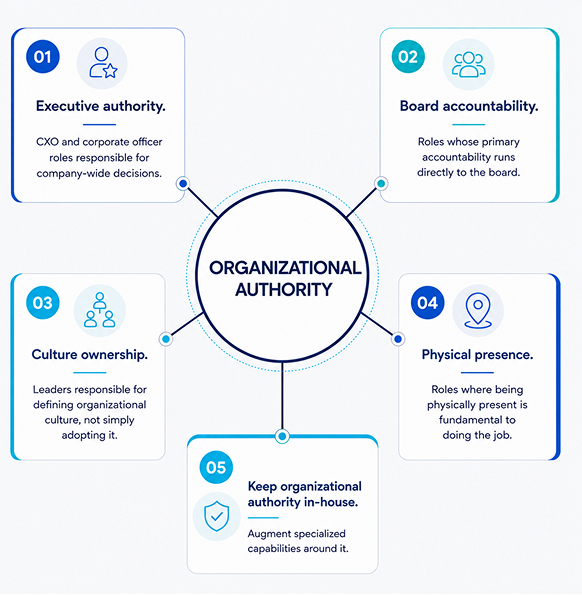
Staff augmentation can support highly specialized, senior, and strategic work. But some roles get their value from their position inside the organization itself. A simple way to spot them is to look for four signals.
Seniority Doesn't Equal In-House
A common assumption is that outsourcing works for execution while senior and strategic talent belongs in-house. That is the wrong distinction. The useful question is not how senior the person is. It is whether the role needs organizational authority to create value.
Expertise can be external. Organizational authority usually should not be.
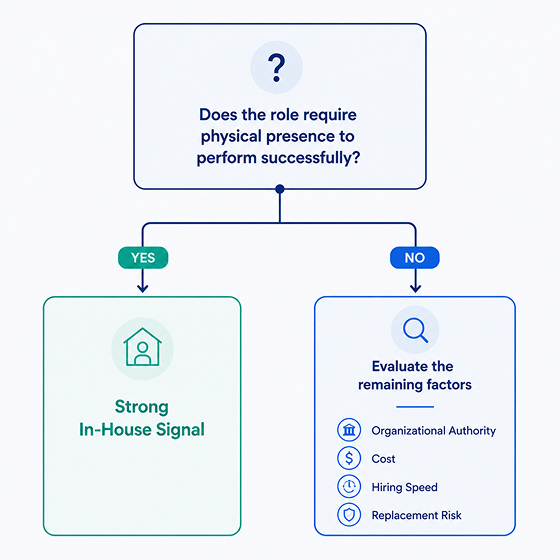
Does the Role Actually Require Physical Presence?
If the work needs consistent physical presence, an in-house model often makes more sense. If the role can be performed fully remotely, geography stops being a reason to require in-house employment.
Remote work is not the same as staff augmentation. But when a role can be done remotely, one of the strongest structural reasons for keeping it in-house goes away.
39 Days to Hire. And That's Before the Work Begins.
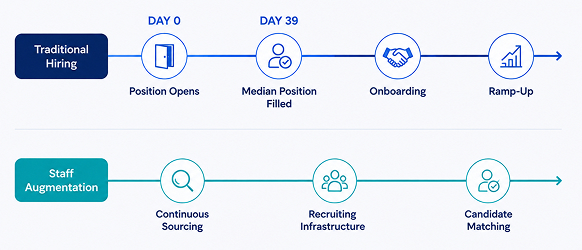
39 days is the median time to fill a nonexecutive position in 2026. And filling the seat is only the start.
After the position is filled come the offer, the notice period, onboarding, and the ramp-up before the new person is fully productive. Staff augmentation changes the recruiting math by working with providers whose core business is continuously sourcing, evaluating, and maintaining access to talent.
Source: https://www.shrm.org/topics-tools/research/recruiting-benchmarking
Your $100K Hire Doesn't Cost $100K
Salary is only one part of the cost of employment. For U.S. private-industry workers, wages and salaries make up 69.9% of employer compensation costs, and benefits make up the other 30.1%. And that is before you count the internal cost of recruiting, onboarding, and managing the hiring process.
Compare employment models on total cost, not salary alone.
Source: https://www.bls.gov/news.release/ecec.nr0.htm
The Real Cost Starts When the Hire Doesn't Work Out
When a hire doesn't work out, the cost is not just starting recruiting again. It usually means lost productivity, another search, another onboarding, and another ramp-up period.
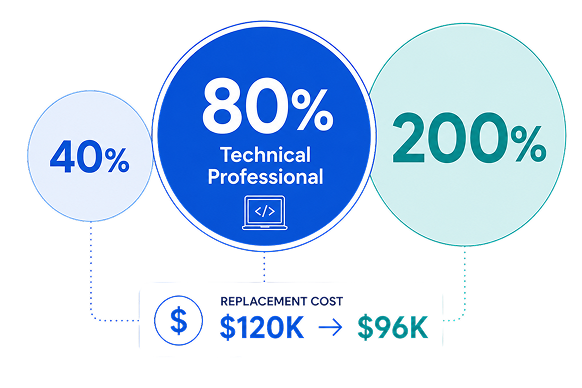
Gallup estimates the cost of replacing an employee at roughly 40% of salary for a frontline employee, 80% for a technical professional, and 200% for a manager or leader.
As an illustration, replacing a $120,000 technical professional can represent about $96,000 in replacement cost.
Source: https://www.gallup.com/workplace/646538/employee-turnover-preventable-often-ignored.aspx
In an in-house model, a bad fit runs through termination, then recruiting again, interviewing again, and onboarding again. With staff augmentation, a bad fit can be handled through a provider-led replacement instead. Strong staffing agreements can shift a meaningful part of that replacement risk to the provider.
Which Model Fits Your Next Hire?
Run every open position through five questions.
1. Does the role require executive or board-level authority? If yes, keep it in-house.
2. Is the person responsible for creating organizational culture? If yes, keep it in-house.
3. Does the role fundamentally require physical presence? If yes, keep it in-house.
4. Would faster recruiting or easier replacement materially help the company? If yes, staff augmentation gains an advantage.
5. Is total employment cost materially higher than an equivalent staff augmentation solution? If yes, staff augmentation gains an advantage.
Seniority and role duration don't need to decide the answer.
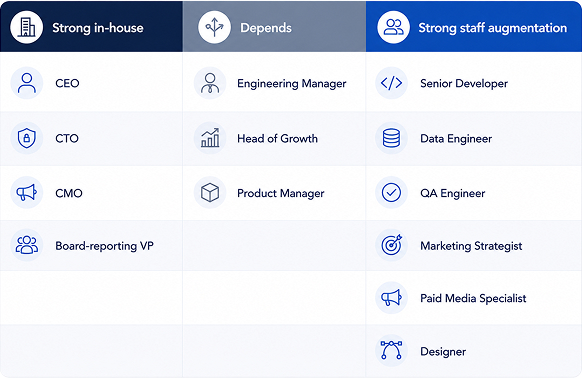
These roles are examples, not universal rules.
Build the Team You Need. Not the Payroll You Don't.
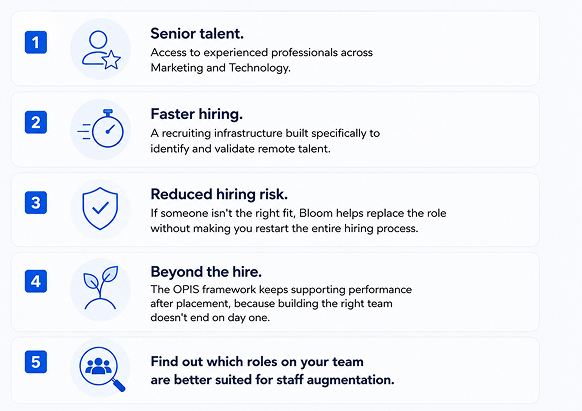
Bloom helps companies across the United States and Canada build high-performing remote Marketing and Tech teams through staff augmentation.
References
Deloitte. Global Outsourcing Survey. https://www.deloitte.com/us/en/services/consulting/articles/global-outsourcing-survey.html
SHRM. 2026 Recruiting Benchmarking. https://www.shrm.org/topics-tools/research/recruiting-benchmarking
U.S. Bureau of Labor Statistics. Employer Costs for Employee Compensation, March 2026.
https://www.bls.gov/news.release/ecec.nr0.htm
Gallup. Employee Turnover: Preventable but Often Ignored.
https://www.gallup.com/workplace/646538/employee-turnover-preventable-often-ignored.aspx